

Feeling grounded means your attention is in the same place as your body, instead of running ahead into what is next or back over what already happened. You feel more grounded every day by setting a small number of moments when you come back to your senses on purpose, rather than waiting for a day quiet enough to notice. This is the psychological sense of the word, not the electrical one, and not the practice of walking barefoot on grass.
Grounding techniques like the 3-3-3 rule and 5-4-3-2-1 are built for a moment that has already gone wrong, and they are good at that. The daily version is a different problem: shorter, plainer, repeated, and mostly a question of what reminds you. What follows is what being ungrounded actually is, why an ordinary day produces it, what the named techniques do and when they help, and what makes the practice survive a normal week.

What does it mean to feel grounded?
Feeling grounded means your attention is in the same place as your body. You are aware of the room, your weight on the chair, the sound in the background and the fact that you are breathing, without having to stop what you are doing to check. Feeling ungrounded is the opposite: your body is at the kitchen counter and your attention is in tomorrow's meeting.
It is worth being clear about the word, because it carries three unrelated meanings:
- Electrical grounding, a safe path for current to reach the earth. Unrelated to this article.
- Earthing, direct physical contact with the ground, usually barefoot. A separate claim with a separate and much weaker evidence base.
- Psychological grounding, where the word describes where your attention sits. This is the one the article is about, and it works indoors, in shoes, at a desk.
Groundedness is not a clinical category, so nobody measures it directly. The closest measured thing is how ordinary days feel. In 2024, 37% of adults worldwide told Gallup they had experienced stress a lot of the previous day, and 39% said the same about worry, across 144 countries and territories. Stress was seven points higher than a decade earlier, when it sat at 30%, and worry five points higher, from 34%.
What are the signs that you are not grounded?
The signs are mostly small failures of attention rather than feelings. You notice them after the fact, which is part of what makes the state hard to interrupt.
Common ones:
- Arriving at the end of a task with no memory of doing it, like a drive home or a page of email.
- Reading the same paragraph twice and still not knowing what it said.
- Finding tension in your jaw, shoulders or hands only when you finally stop moving.
- Reaching for your phone before you have decided to.
- The day feeling compressed afterwards, as though several hours passed without any detail in them.
One distinction is worth drawing carefully. Ordinary autopilot is not the same as dissociation, which is a persistent sense of detachment from your body or surroundings and is a clinical experience with clinical support behind it. If the feeling is constant, frightening, or arrives with memory gaps, that is a conversation for a doctor rather than a breathing exercise.
Why does an ordinary day pull you out of it?
Because attention drifts by default. The clearest evidence for that comes from a study that sampled people inside their real days rather than in a laboratory.
Psychologists Matthew Killingsworth and Daniel Gilbert contacted 2,250 adults at random moments and asked what they were doing and whether they were thinking about something else. Minds were elsewhere in 46.9% of the samples, and in at least 30% of samples during every activity they measured except one. Whether people's minds had wandered also predicted how they felt better than what they were actually doing did: mind wandering accounted for 10.8% of the variation in a person's happiness across moments, while the activity itself accounted for 4.6%.
Share of sampled moments in which people's minds were not on what they were doing, across 2,250 adults (Killingsworth and Gilbert, Science, 2010).
That number changes what the job is. Holding attention in place all day is not something people do. Coming back more often is.
What is the 3-3-3 rule for grounding?
The 3-3-3 rule is a short sensory exercise that takes under a minute and needs nothing but the room you are in:
- Name three things you can see.
- Name three things you can hear.
- Move three parts of your body.
It is worth being honest about where it comes from. The 3-3-3 rule appears widely in counseling blogs and mental health writing, but it has no named originator and no trial testing it as a discrete technique. What it has is a plausible mechanism, shared with better-documented sensory exercises: it hands your attention a small, finite, external task, and finishing that task is incompatible with continuing the loop you were in.
That mechanism also tells you where it falls down. A rule with three steps and nine items is something you have to remember, decide to do, and complete. It works when you already know you are spiraling. It does almost nothing on a day when you never notice you have drifted.
Do grounding techniques like 5-4-3-2-1 actually work?
They work for what they were designed for, which is a moment that has already tipped, and they are weaker as a daily practice. The 5-4-3-2-1 technique walks down through the senses: acknowledge five things you see, four things you can touch, three things you hear, two things you can smell and one thing you can taste. The University of Rochester Medical Center describes it as a coping technique to "ground you in the present when your mind is bouncing around between various anxious thoughts", and offers it as one option among several rather than as a treatment.
That framing matters. These are rescue tools, and they are good ones. If an already difficult afternoon is the problem you are trying to solve, our article on quick ways to calm down during a stressful day covers what the evidence supports once a day has gone wrong.
Daily grounding is a different problem, and the two are easier to tell apart side by side.
| Practice | Time it takes | What it is for | Where it falls down |
|---|---|---|---|
| 3-3-3 rule | Under a minute | A moment you have already noticed going wrong | Has to be remembered, decided on, and completed |
| 5-4-3-2-1 | One to two minutes | Anxious thoughts that are already looping | Conspicuous in company, and too long to repeat often |
| A single deliberate breath | Seconds | Returning attention to the body mid-task | Almost invisible, which also makes it easy to skip |
| Time outside | Ten minutes or more | Changing what a whole afternoon feels like | Needs a break you may not control |

What makes grounding daily instead of occasional?
The cue does. Knowing a technique and using it are different problems, and the second one is where daily practice is won or lost.
The gap between the two is well documented. Reviewing the evidence on intentions and behavior, Paschal Sheeran and Thomas Webb report that intentions get translated into action approximately one half of the time, and that most of the shortfall comes from people who fully meant to act and then did not, rather than from people who never intended to. In experiments, a medium to large change in someone's intention produced only a small to medium change in their behavior.
Grounding makes that gap wider than usual, because using a technique depends on noticing that your attention has gone, and not noticing is the state itself. The cue has to come from somewhere other than your own attention. In practice it comes from one of four places:
- A fixed point in the day. Not a time, which you will miss, but a moment attached to something you already do: after you sit down, before you open the laptop, while the coffee brews.
- A place. A doorway, a set of stairs, the walk from the car. Physical thresholds work because they happen whether you remember them or not.
- Another person. A colleague who takes the same afternoon walk, a partner who eats without a screen.
- Something that interrupts you on its own. A timer, an alarm, or an object you wear that prompts you without you having to decide.
Each has a cost. A fixed point survives only as long as the routine around it does. A place works until you change your commute. Another person is reliable and not available on demand. An interruption you did not schedule is the most dependable and the most intrusive, which is why its form matters: arriving on a screen puts it alongside everything else competing for you, and it tends to get treated the same way.
The mechanics underneath all four are the ordinary mechanics of repeated behavior, which we covered in how to build a new habit that sticks.
How much does it take to make a difference over a week?
Less in each sitting than most advice implies, and more often. The clearest number on this comes from time spent outdoors, where the question has actually been measured at scale.
A study of 19,806 people in England, published in Scientific Reports, found that those who spent at least 120 minutes in nature in the previous week reported good health and high well-being significantly more often than those who spent none. People who spent between 1 and 119 minutes showed no measurable difference from people who spent none at all. Above the threshold, the association rose and then flattened out somewhere between 200 and 300 minutes a week.
The detail that matters most for an ordinary week is how that time was reached. The researchers found "no differences in health and well-being as a function of how high exposure was achieved": one visit of 120 minutes or more, two visits of an hour or more, or three or more visits of 40 minutes or less all sat at the same level. The weekly total did the work. The shape of it did not.
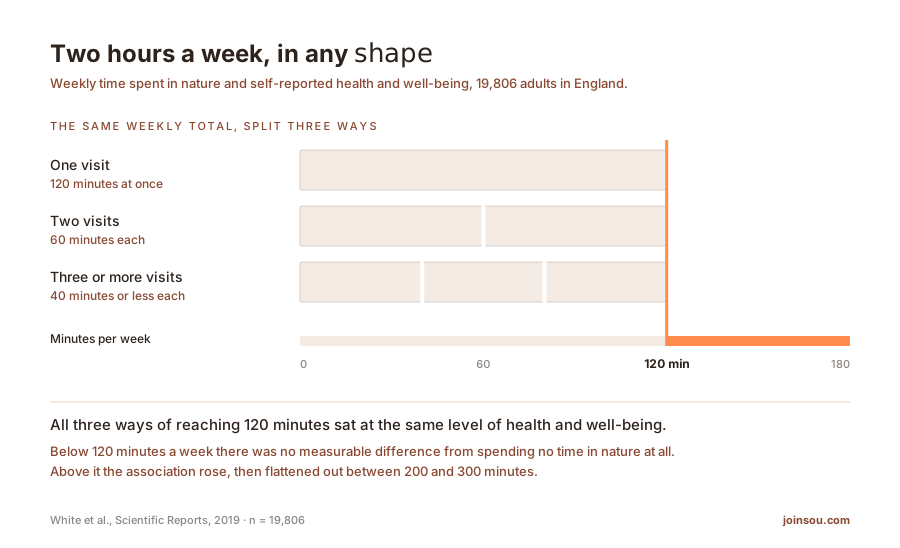
| Weekly time in nature | How it was taken | Self-reported health and well-being |
|---|---|---|
| Under 120 minutes | Any pattern | No measurable difference from none at all |
| 120 minutes or more | One visit of 120+ minutes | Significantly higher than none |
| 120 minutes or more | Two visits of 60+ minutes | Same as the single long visit |
| 120 minutes or more | Three or more visits of 40 minutes or less | Same as the single long visit |
Source: White et al., Scientific Reports, 2019 (n = 19,806). Above 120 minutes the association rose and then flattened out between roughly 200 and 300 minutes a week.
That is the practical case for daily over occasional, in one of the few places where it has actually been measured. Twenty minutes outside on five days of the week lands in the same band as a long Sunday walk, and it is considerably easier to keep. The same logic applies indoors and at a much smaller scale: a return that takes seconds, taken several times a day, asks less of a calendar than a practice that needs a free half hour.
Decide your default now Pick one thing you will do, and one moment you will do it in, before you need it. "After I sit down at my desk, one slow breath and one look out the window" is a complete plan. Choosing in the moment is the step that usually does not happen.
Conclusion
Grounding techniques are short, free and largely interchangeable. What decides whether you use one is whether anything in your day brings you back when your attention has quietly gone somewhere else, which is why the cue is worth more thought than the technique.
Most people end up relying on one of four cues: a fixed point in the routine, a place they pass through, another person, or something that prompts them without being asked. The Sou Band sits in that last group: a small pebble worn as jewelry, on a strap, that gives a gentle vibration at points through the day, spaced so they are not predictable, with no screen and nothing to read. Some people use it as the prompt for exactly the kind of short return described above. If you want the wider picture of what that category includes, more about that in what a mindfulness wearable is.