

The fastest way to calm down during a stressful day is a physiological sigh: two breaths in through the nose, then one long, slow breath out through the mouth. It works within one to three breaths, needs no equipment, and nobody sitting near you will notice you doing it.
That answer matters because most published relaxation advice is not usable in the situation people are actually in when they search for it. It is 3pm, you have a meeting in six minutes, and you are at a desk with colleagues either side of you.
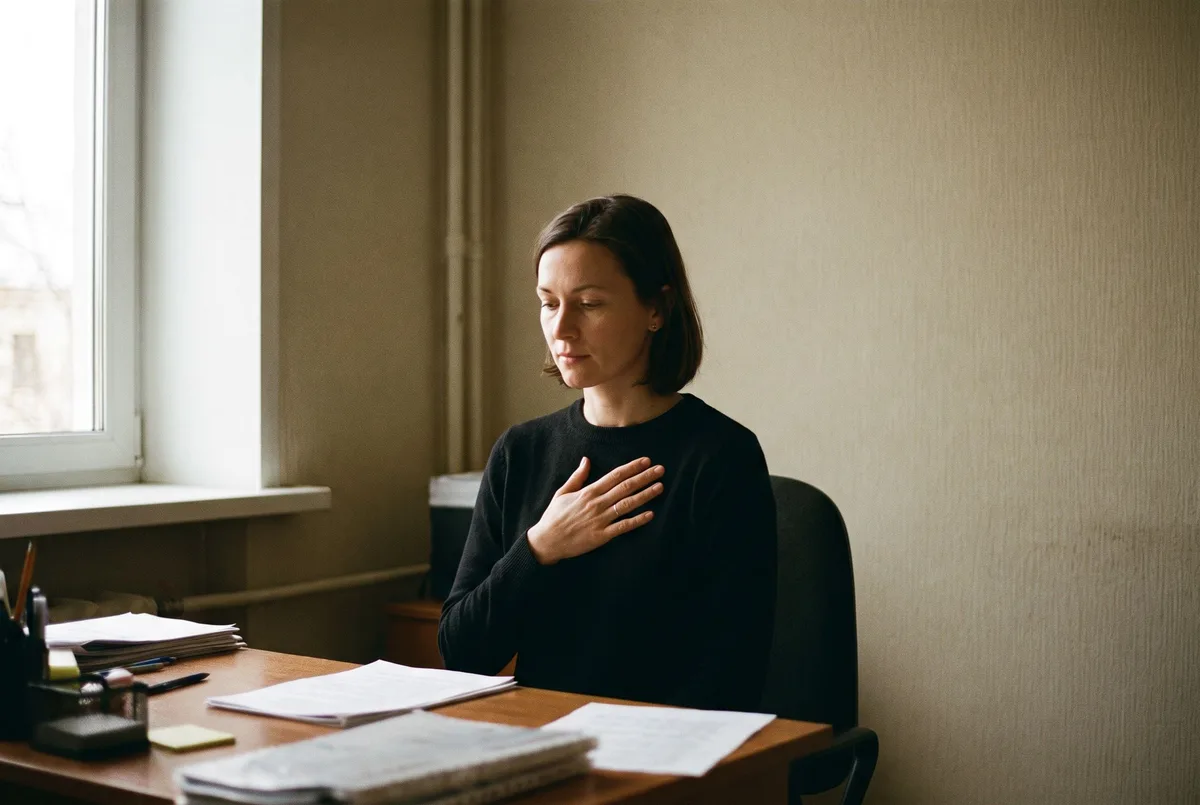
Why does most relaxation advice not work during a stressful day?
Because it quietly assumes conditions you do not have. Read almost any guide to relaxation techniques and you will find progressive muscle relaxation, visualization and autogenic training near the top. These are legitimate methods with real evidence behind them. They are also, by their own instructions, things you do lying down in a quiet room with the door shut for fifteen to twenty minutes.
Many guides say this outright, then still file the techniques under quick stress relief. Tense each muscle group for five seconds and release for thirty, working from your toes to your head. Close your eyes, loosen tight clothing, and imagine the sound of waves. That is excellent advice for a Sunday evening. It is unavailable to you between two meetings.
The gap is not effectiveness. It is availability. A technique that works brilliantly under conditions you cannot create is, at 3pm on a Tuesday, worth nothing at all.
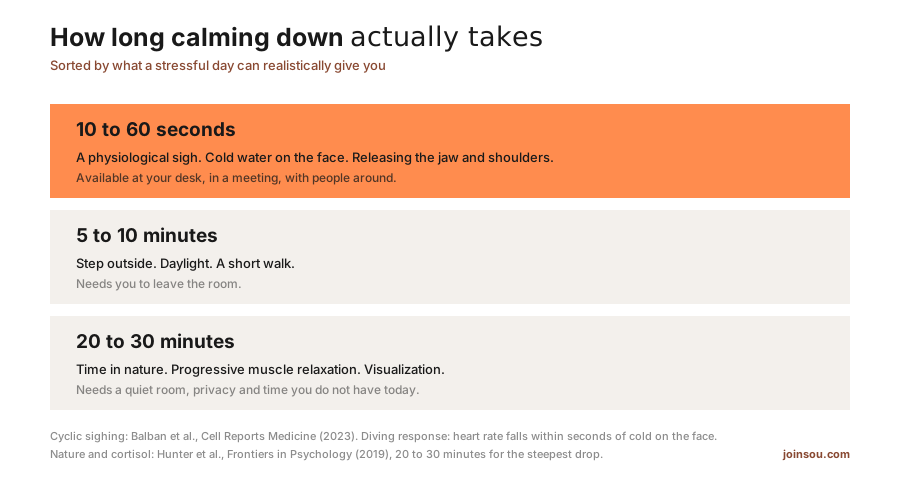
| Time needed | Techniques | What it requires |
|---|---|---|
| 10 to 60 seconds | Physiological sigh, cold water on the face, releasing jaw and shoulders | Nothing. Works at your desk, with people around |
| 5 to 10 minutes | Step outside, daylight, a short walk | Leaving the room |
| 20 to 30 minutes | Time in nature, progressive muscle relaxation, visualization | A quiet room, privacy and time |
So the useful way to sort these is by two questions nobody seems to ask: how long does it take, and can you do it with people around?
What is the fastest way to calm down?
A physiological sigh, also called cyclic sighing. Two inhales through the nose, the second one shorter and stacked on top of the first, then a long slow exhale through the mouth. One to three rounds is enough to feel a shift.
The exhale is doing the work. A randomized controlled trial at Stanford compared five minutes a day of breathwork against five minutes of mindfulness meditation over a month, and the group doing exhale-focused cyclic sighing improved mood more than the meditation group and lowered their resting respiratory rate. The effects were measurable after a single five-minute session (Balban et al., Cell Reports Medicine, 2023).
Two features make it the right tool for a stressful day specifically. It takes seconds rather than minutes. And it is invisible: there is no posture, no closed eyes, no equipment. You can do it in a meeting while someone else is talking.
A physiological sigh, two inhales and one long exhale, shifts the body's stress response within a few breaths. Exhale-focused breathing outperformed equal-time mindfulness meditation for mood in a Stanford randomized trial (Balban et al., Cell Reports Medicine, 2023).
What else can you do in under a minute?
Three things, all of them available without leaving your chair or announcing anything.
- Release your jaw and shoulders. Under stress most people clench without noticing. Unclenching is instant, free, and completely invisible. It will not resolve the stress, but it interrupts the physical loop that feeds it.
- Lengthen the exhale on ordinary breaths. You do not need a formal technique. Breathe in for a count of four, out for six, for four or five rounds. Longer out-breaths are the active ingredient in nearly every calming breath protocol.
- Cold water on the face. This one is faster and stronger than it sounds, and it is the only item here that needs you to reach a bathroom.
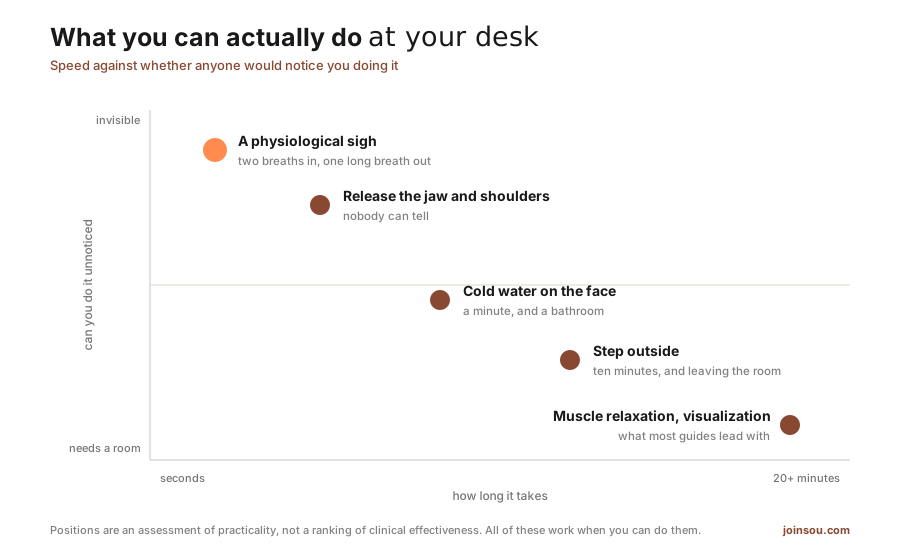
| Technique | Time | Can you do it unnoticed |
|---|---|---|
| A physiological sigh | Seconds | Yes, invisible |
| Release the jaw and shoulders | Seconds | Yes, invisible |
| Cold water on the face | About a minute | Needs a bathroom |
| Step outside | Ten minutes | Means leaving the room |
| Muscle relaxation, visualization | 20+ minutes | Needs a private room |
Does cold water actually help you calm down?
Yes, and the mechanism is well described. Cold on the face, particularly around the forehead and cheeks, triggers the diving response: heart rate slows, blood is redistributed, and the parasympathetic system takes over. It happens within seconds and does not require you to believe in it.
Water at roughly 10 to 15°C held on the face for 15 to 30 seconds is enough, and reported heart rate reductions from the response run from around 12% upward depending on temperature and the individual (Ochsner Health). It is used clinically for exactly this purpose, as one of the distress tolerance skills taught in dialectical behavior therapy, where it is prescribed for acute emotional overwhelm.
The practical version at work is undramatic: cold tap water on your wrists and face in the bathroom, thirty seconds, done.
What if you have ten minutes?
Step outside. Daylight and movement together do more than either alone, and this is the tier where a genuine physiological recovery starts rather than just an interruption.
Time in nature reliably lowers cortisol, but it is worth being precise about the dose. Researchers who measured salivary cortisol before and after outdoor sessions found the steepest drop came from 20 to 30 minutes spent sitting or walking somewhere green, with the benefit accruing more slowly after that (Hunter et al., Frontiers in Psychology, 2019). Ten minutes still helps. It is just not the same intervention as ten seconds.
This is why the tiers matter. A walk is a better tool than a breath, if you have the ten minutes. Most of the time, in the middle of the day you are describing when you search for this, you do not.
What works, and what only sounds like it should?
Being honest about the weaker options is more useful than listing everything:
- Strong and fast: exhale-focused breathing, cold on the face, releasing physical tension.
- Strong but slow: time outdoors, progressive muscle relaxation, visualization, exercise. Real effects, wrong timescale for an acute moment.
- Thin or overstated: most aromatherapy claims, "calming" playlists as a reliable physiological intervention, and elaborate breath patterns with specific mystical counts. Some people find these genuinely pleasant, which has value, but the evidence for a rapid physiological shift is much weaker than for a long exhale.
If a technique requires you to believe in it to work, treat that as a caution rather than a feature.
Decide your default now Pick one thing you will do the next time a day turns. Make it the physiological sigh unless you have a reason to prefer something else. In the moment, you will not evaluate options, you will only reach for whatever you already decided.
How do you remember to calm down when you are stressed?
This is the part almost every guide leaves out, and it is the reason knowing all of the above changes less than it should.
Stress narrows attention. The moment you most need a reset is the moment you are least likely to think of one, because your attention has already collapsed onto whatever is causing the stress. People do not fail at calming down because the techniques are hard. They fail because at 3pm the thought never arrives.
There are a few honest answers. Attach the breath to a fixed cue you already have, the start of every meeting, every time you sit back down, every red light. Build it as a habit rather than an emergency measure, which we went through in how to build a new habit that sticks. Or use something external that arrives on its own, without you having to remember.
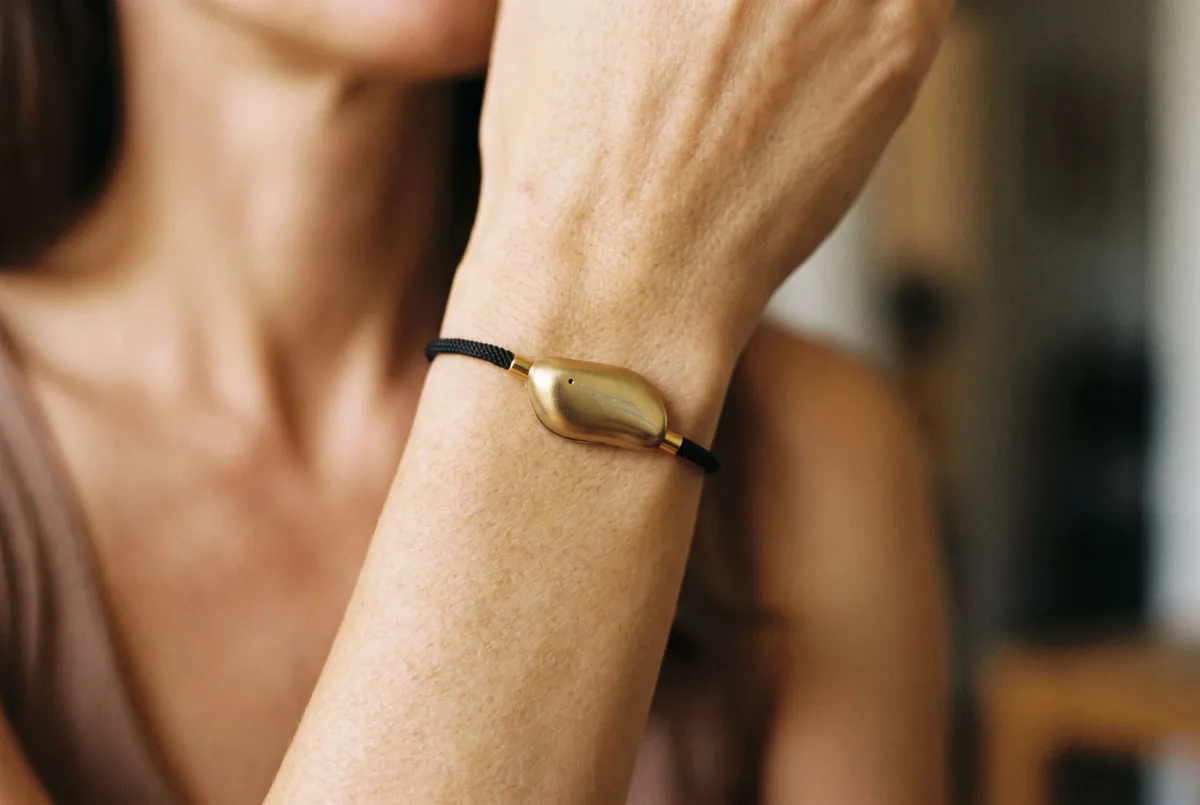
Sou is one option in that last category, a mindfulness wearable that gives a gentle vibration at intervals through the day, with no app and no screen, which many people use as a prompt for exactly this kind of reset. A note on your monitor or a recurring alarm does a version of the same job. We looked at the trade-offs between screen-based and physical prompts in the benefits of screen-free reminders.
The technique is not the hard part. Two breaths in, one long breath out, and you are already doing it. The hard part is being reminded, in the middle of a day that has stopped leaving room for it. If the problem is less about one bad afternoon and more about how most days go, we covered that separately in how to feel more grounded every day.