

To remember to drink more water during the day, stop relying on thirst and attach drinking to something that already happens: a meal, a meeting, a walk past the kitchen. Thirst usually only registers once you are already 1 to 2% dehydrated, which is past the point where attention and mood start to slip. A reminder that arrives on its own works better than one you have to remember to check.
Most hydration advice answers a question you did not ask. You probably already know you should drink more water. The difficulty is that the intention arrives at 8am and the day eats it.
Why is it so hard to remember to drink water?
Because nothing reliably tells you to. Eating has hunger, a schedule, and other people. Drinking water has none of that during a working day. There is no meeting invite, and the one internal signal you do have is slower than you think.
Mayo Clinic's own guidance puts it plainly: increasing your water intake may seem easy, but it can take a lot of work to remember to drink up. That is the actual problem, and most tip lists move straight past it.
Is thirst a reliable signal to drink?
No, and this is the part worth knowing. Thirst is a lagging indicator. According to Lawrence Armstrong at the University of Connecticut, whose lab ran two of the best-known studies on this, thirst sensation does not really appear until you are 1 to 2% dehydrated, and by then dehydration is already starting to affect how your mind and body perform (UConn Today).
That matters because the effects begin early. In controlled studies of healthy adults, attention and concentration were impaired at around 1.5% body water loss, with mood, headache and perceived task difficulty all worsening (Ganio et al., British Journal of Nutrition, 2011; Armstrong et al., Journal of Nutrition, 2012).
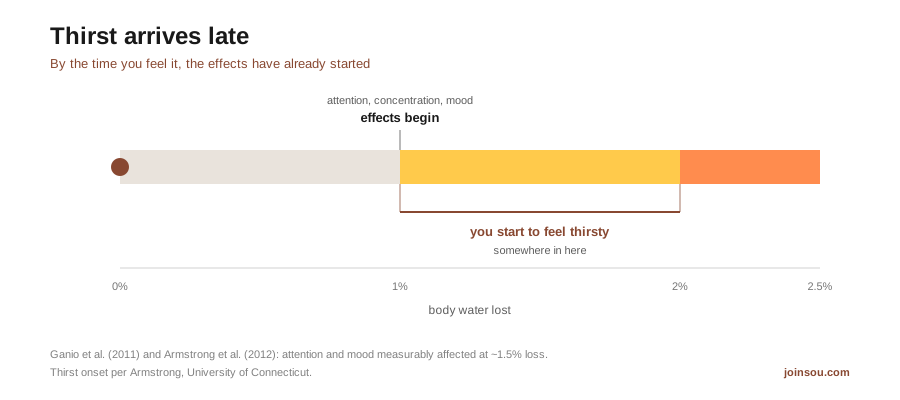
| Body water lost | What is happening |
|---|---|
| 0 to 1% | No noticeable effect |
| ~1 to 1.5% | Attention, concentration and mood measurably affected |
| 1 to 2% | Thirst usually becomes noticeable |
Sources: Ganio et al. (2011), Armstrong et al. (2012), and Armstrong via University of Connecticut.
So the sequence runs the wrong way around. The fog arrives, then the thirst. If you are waiting to feel thirsty before you drink, you are using the smoke alarm as a kitchen timer.
Body water loss at which attention, concentration and mood are measurably affected, before most people register thirst (Ganio et al. 2011; Armstrong et al. 2012).
How much water do you actually need?
European guidance from EFSA suggests a total daily water intake of about 2.5 litres for men and 2.0 litres for women, including the roughly 20 to 30% that comes from food. Mayo Clinic's US guidance is higher, at 15.5 cups (3.7 litres) for men and 11.5 cups (2.7 litres) for women, again including food.
The numbers differ, which tells you something: precision here is less useful than consistency. And most people are not close to either figure. In a study of 16,276 adults across 13 countries, only 40% of men and 60% of women met the EFSA guideline for water from fluids (Public Health Nutrition / European Journal of Nutrition data, via PMC).
That gap is not a knowledge gap. Very few of those people would have said they drink enough.
Which hydration tips actually help you remember?
Most of the standard advice is good, but it solves different problems, and only some of it addresses remembering. Worth being clear about which is which:
| Common advice | What it actually solves | Does it remind you? |
|---|---|---|
| Add fruit or flavor to your water | Makes it more appealing to drink | No |
| Eat water-rich foods | Adds to total intake | No |
| Carry a bottle with you | Removes the access barrier | Only if you see it |
| Use a marked or timed bottle | Access plus a visual target | Only when it is in front of you |
| Alternate water with other drinks | Reduces other beverages | No |
| Compete with a friend | Adds motivation | Briefly |
| Tie it to something you already do | Supplies a reliable trigger | Yes |
| Set a recurring cue | Supplies a trigger you don't have to recall | Yes |
Two of eight. The rest are worth doing, but if the thing you are missing is the prompt, they will not fix it.
What is the best way to remind yourself to drink water?
Anchor it to something that already happens, then cover the gaps with a cue that arrives on its own.
Anchor first. Pick moments that occur daily without you deciding: every meal, every time you brush your teeth, every time you sit back down at your desk, the start of every call. Drinking a full glass at four fixed moments gets most people most of the way there, and it costs no memory at all because the anchor does the remembering.
Then cover the middle. Anchors are reliable but sparse. They handle four or five moments and leave the six hours in between uncovered. That is where an external cue earns its place, and the options differ mostly in whether they reach you when you are not looking.
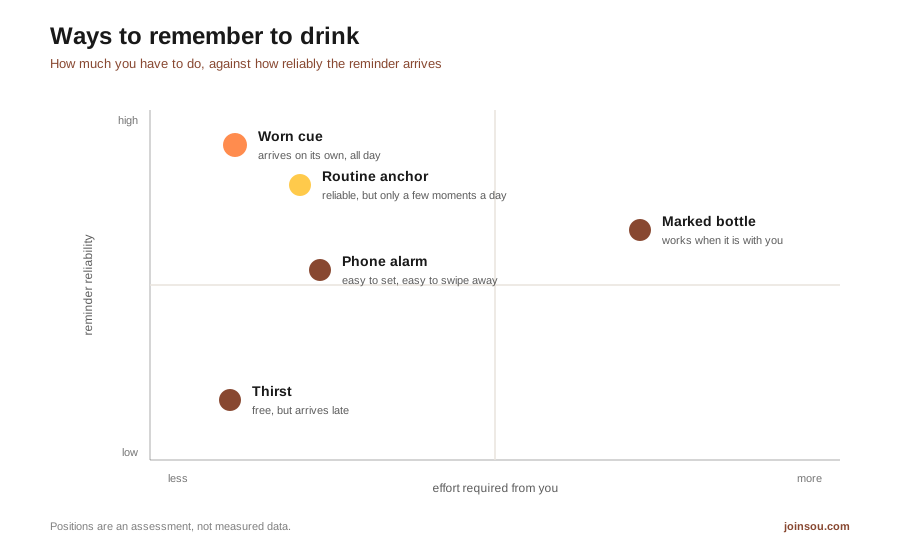
| Method | Effort | Reliability | Note |
|---|---|---|---|
| Thirst | None | Low | Arrives late |
| Phone alarm | Low | Medium | Easy to set, easy to swipe away |
| Marked bottle | Medium | Medium-high | Works when it is with you |
| Routine anchor | Low | High | Reliable, but only a few moments a day |
| Worn cue | Low | High | Arrives on its own, all day |
Positions are an assessment, not measured data.
Drink before you feel like it Because thirst lags, the useful habit is drinking on a schedule rather than on a sensation. One glass at each of four fixed daily moments, plus whatever the gaps ask for, beats waiting for a signal that arrives late.
A phone alarm is free and repeats forever, but it lands in the same stream as every other notification, which is where reminders go to be dismissed. A marked bottle works well when it is on your desk and does nothing when it is in the kitchen. A worn cue, a wearable that taps you at intervals, arrives without a screen and travels with you, at the cost of buying something. None of these is obviously right. What they have in common is that the good ones do not require you to remember to check them.
How do you make it stick?
Start with one anchor, not eight. Add the second only when the first happens without you thinking about it.
This is ordinary habit formation, and the same rules apply as anywhere else: small, attached to an existing routine, and given longer than you expect. We wrote about that in more detail in how to build a new habit that sticks.
The reason to bother is not the number on a bottle. It is that mild dehydration is one of the most common and least noticed reasons a normal afternoon feels harder than it should. The fix is trivial. Remembering is the only difficult part.
If a physical prompt is what is missing for you, that is a solvable gap and worth solving deliberately, whether with an anchor, an alarm, or something you wear. Sou is one option in that last category, a mindfulness wearable that delivers a gentle vibration at intervals through the day with no app and no screen, which people use as a cue for a breath, a stretch, or a glass of water. The same interval cue that supports presence works for hydration, because the underlying problem is identical: the thing you meant to do, at the moment you would otherwise forget.