

Micro-moments of mindfulness are brief, deliberate pauses, often just one slow breath, taken many times throughout the day. For everyday stress, research increasingly suggests they can work as well as or better than a single long meditation session, not because they are more powerful, but because they actually happen. A practice you do beats a practice you plan.
This is not an argument against meditation. It is an argument about what survives contact with a real life.

What is a micro-moment of mindfulness?
A micro-moment of mindfulness is a deliberate return to the present that takes seconds: one slow breath before you open your laptop, a pause to feel your feet on the floor while the kettle boils, three seconds of attention on the street noise instead of your thoughts. Done once, it is a nice moment. Done fifteen or twenty times a day, it becomes a practice.
The difference from meditation is structural, not spiritual. Meditation gathers presence into one dedicated block. Micro-moments distribute it through the day, into the places where stress actually shows up: the inbox, the commute, the minute before a difficult call.
Why is meditation so hard to stick with?
Because it asks for the three things a stressful life has least of: a block of time, a quiet place, and the motivation to use both on a hard day. None of that is a flaw in meditation itself. The research behind meditation is substantial, and people who maintain a practice tend to benefit from it. The problem is the maintaining.
The numbers are stark. An analysis of real-world usage data published in JMIR found that mindfulness and meditation apps retain a median of just 4.7% of their users 30 days after download. Everyone else quietly stopped.
Median share of meditation app users still active 30 days after download, from objective usage data across mental health apps (Baumel et al., JMIR, 2019).
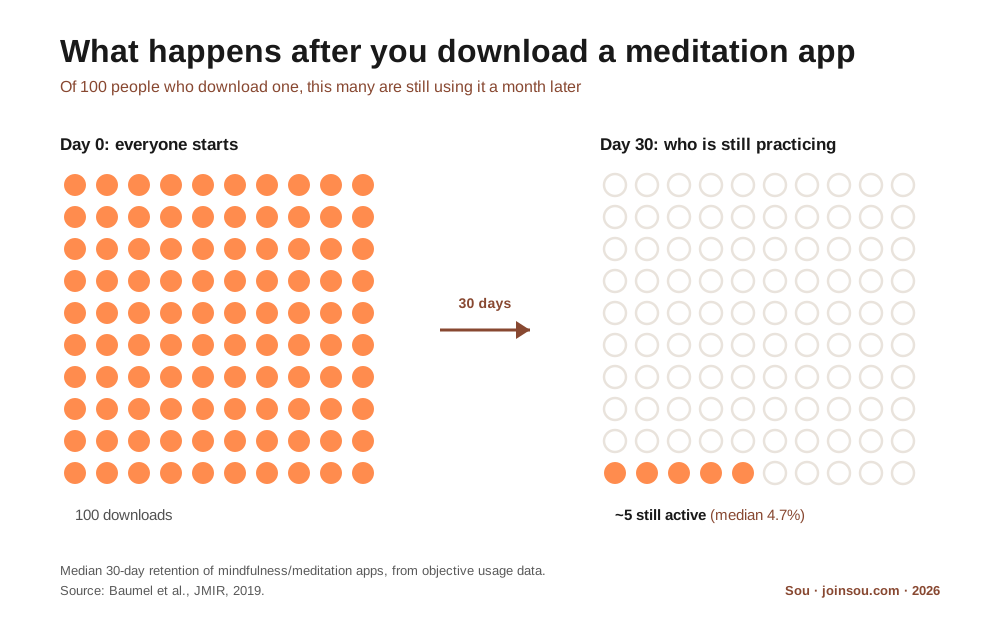
| Stage | Users |
|---|---|
| Download the app (day 0) | 100 out of 100 |
| Still active at day 30 (median) | ~5 out of 100 |
Source: Baumel et al., objective usage analysis of mental health apps, JMIR 2019.
Part of what drives this is the all-or-nothing trap. When the practice is defined as twenty minutes, a day without twenty minutes becomes a day without practice. Miss enough of those and the habit is gone. The bar was set at a height that a normal week knocks over.
Can a few seconds of mindfulness actually work?
Yes, and this is where the research has become genuinely interesting. A randomized controlled study from Stanford, published in Cell Reports Medicine, compared five minutes a day of breathing exercises against five minutes of mindfulness meditation for a month. The breathing group, specifically the one emphasizing long exhales (cyclic sighing), improved mood more than the meditation group and lowered their resting respiratory rate. Notably, the effects were measurable after a single five-minute session.
The fastest version of this is the physiological sigh: two inhales through the nose, one long exhale through the mouth. It works in one to three breaths, which puts a real reset inside a window of a few seconds. That is the mechanism underneath the micro-moment idea: you are not doing a miniature meditation, you are triggering a short, well-understood physiological shift, many times a day.
The honest caveat: head-to-head research comparing distributed micro-practice against long sessions over months is still emerging. What is well supported is that brief practices produce measurable effects, and that the biggest predictor of benefit from any practice is whether you keep doing it.
How do micro-moments compare with meditation sessions?
They solve different problems, and the honest comparison looks like this:
| Compared on | 20-minute meditation session | Micro-moments through the day |
|---|---|---|
| Time needed | A dedicated block | Seconds, no block required |
| Where it happens | Somewhere quiet | Anywhere: desk, street, meeting |
| What it demands | Time + motivation, daily | Almost nothing per moment |
| What kills it | Busy days, travel, bad weeks | Forgetting |
| Depth per sitting | High | Low per moment, cumulative |
| Where stress is met | Before or after the day | Inside the day, as it happens |
| Best for | Deepening a practice you already keep | Building presence into a full life |
Both are legitimate. If you sit twenty minutes a day and it holds, keep sitting. The comparison matters for everyone else, the people the 4.7% statistic describes, for whom the choice is not between meditation and micro-moments but between micro-moments and nothing.
Notice the one weakness in the right-hand column: forgetting. A practice that takes three seconds is easy to do and even easier to not do. Every approach to micro-moments, from phone reminders to sticky notes to haptic cues you wear, is an answer to that single problem.
Picture your day. Where would a session fit, and where would a breath fit?
Try it concretely. It is 3pm. You have been in calls since ten, the inbox is climbing, and someone just moved tomorrow's deadline to tonight. A twenty-minute meditation is not going to happen, and you know it. Even the suggestion is faintly irritating.

But this is available: while the next call loads, two breaths in through the nose, one long exhale. Shoulders drop maybe a centimeter. You notice you are clenching your jaw, and stop. Four seconds, and you walk into the next hour slightly more here than you would have been.
Run the same test across an ordinary day. The school run, when your head is already at work: one breath at the door before you say goodbye. The supermarket queue, phone half out of your pocket: feel your feet instead, ten seconds. Before opening the email you have been dreading: one long exhale first. None of these moments could hold a session. All of them can hold a breath. That is the entire argument: the day is full of gaps too small for meditation and exactly the right size for a micro-moment.
Why is starting small easier to stick with?
Because small actions do not need motivation, and motivation is the least reliable resource you have. Behavioral research on habit formation, including the University College London study that tracked new habits over months, found automaticity takes on average about 66 days of repetition to build, and that what matters most is consistency, not size. Missing a single day made little difference; abandoning the routine did.
That finding quietly favors the small practice. Sixty-six days of twenty-minute sessions is a serious ask. Sixty-six days of single breaths survives holidays, deadlines, and sick kids. The practice that is almost too small to fail is the one that is still there when the habit finally sets.
Make it too small to skip Start with one micro-moment anchored to something you already do every day: the first sip of coffee, closing the laptop, a red light. One breath, exhale longer than the inhale. Do not add more until the first one happens without you deciding to do it.
There is a second, less obvious benefit: small practices lower the cost of coming back. People who fall off a meditation habit often stay off, because restarting means facing the full twenty minutes again. Falling off a one-breath habit barely means anything. You just take the next breath. The same reset works under pressure too, which is why it shows up everywhere from open-plan offices to the penalty spot at a World Cup.
Do micro-moments replace meditation?
No, and they do not need to. Think of them as different tools in the same drawer. A long session builds depth: sustained attention, a different relationship with your own thoughts. Micro-moments build coverage: presence distributed across the hours where your life actually happens. Many people who keep a sitting practice add micro-moments anyway, and many people who start with micro-moments eventually find a longer practice easier to approach, because the muscle is no longer cold.
If you have twenty minutes and the will to use them, meditate. If you do not, take the breath. The worst outcome is the one the dropout data describes: deciding that because the session is impossible today, presence is too.
The practical challenge with micro-moments is the one named earlier: remembering. Some people anchor them to daily routines. Some use reminders. Some wear a physical cue so the prompt arrives on its own. Sou is one option in that last category, a mindfulness wearable designed jewelry-first that delivers a gentle vibration through the day, with no app and no screen. Whatever does the remembering for you, the practice itself stays the same: a few seconds, taken often, inside the life you already have.