

Meditation apps teach you to practice; mindfulness wearables remind you to return. Apps win on guided depth and structure, but most people stop opening them within weeks. A wearable trades that depth for consistency, and the right choice depends on whether your problem is knowing how to be present or remembering to be.
Both categories have grown fast for the same reason: most of us spend large parts of the day on autopilot and would like to spend less. But they attack the problem from opposite ends. One puts a teacher in your pocket. The other puts a quiet interruption on your body. This comparison looks at what each tool does well, what the research says about how people actually use them, and how to decide, including the case for not choosing at all.
What is the difference between a meditation app and a mindfulness wearable?
A meditation app is a library of guided practice on your phone; a mindfulness wearable is an object on your body that prompts you, usually with a gentle vibration, to come back to the present moment. The app asks for ten to twenty minutes of scheduled attention. The wearable asks for a few seconds, many times a day. More about that second category in our guide to what a mindfulness wearable is.
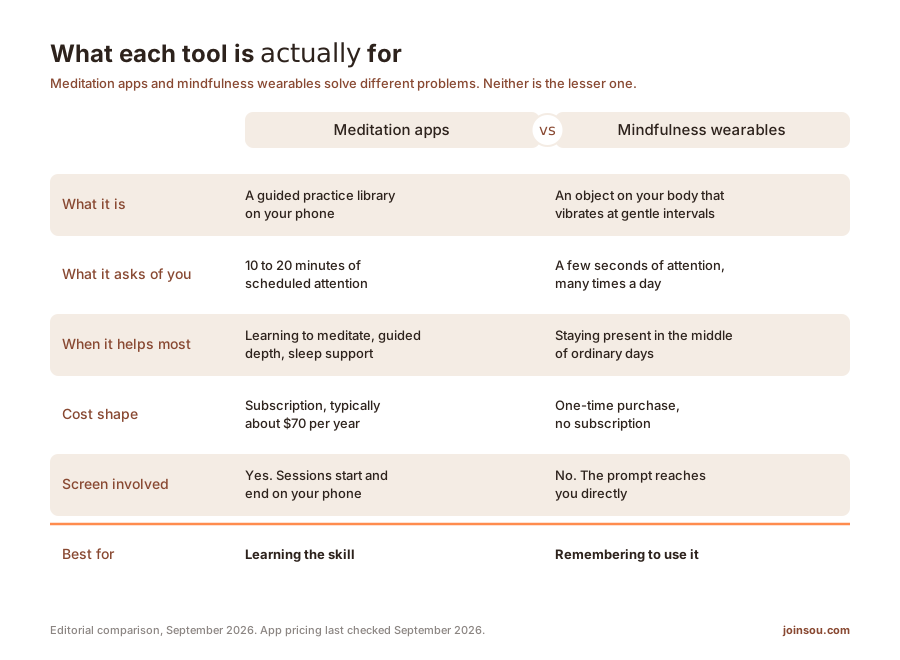
| Compared on | Meditation apps | Mindfulness wearables |
|---|---|---|
| What it is | A guided practice library on your phone | An object on your body that vibrates at intervals |
| What it asks of you | 10 to 20 minutes of scheduled attention | A few seconds of attention, many times a day |
| When it helps most | Learning to meditate, deepening a practice, guided sleep support | Staying present in the middle of ordinary days |
| Cost shape | Subscription, typically about $70 per year | One-time purchase, no subscription |
| Screen involved | Yes. Sessions start and end on your phone | No. The prompt reaches you directly |
Best for: choose a meditation app if you want to learn the skill of mindfulness with guidance and structure. Choose a mindfulness wearable if you already know what a mindful pause feels like and your problem is remembering to take one. Neither is a lesser version of the other; they sit at different points in the same day.
What do meditation apps do well?
Meditation apps are excellent teachers. A good app gives a beginner what a class gives them: a voice to follow, a structure that progresses, and a low-stakes way to learn what meditation actually feels like. The libraries are deep, covering courses for anxiety and focus, single-session breathing exercises, and extensive sleep content.
The evidence behind that promise is real. In a randomized controlled trial published in the Journal of Medical Internet Research in 2026, 135 university staff who used the Headspace app for ten minutes a day reported significantly better sleep quality than a control group at every checkpoint across eight weeks, and slept about 24 minutes longer per night by week five. That is a meaningful result from a small daily practice.
Notice the condition hiding in that sentence, though: ten minutes a day, for eight weeks. Trial participants are supported and reminded in ways ordinary subscribers are not. The honest summary of the research on meditation apps is that they work when they are used. Which raises the obvious question.
Why do most people stop using meditation apps?
Because an app asks you to build a new habit with no external cue, and that is one of the hardest ways to build a habit. A 2026 study in JMIR mHealth and uHealth followed 655 real-world users of the free meditation app Medito across 30 countries and found that fewer than one in five (18.9%) were still using the app after 14 days. Half of all new users spent a total of 16 minutes or less in the app across their entire first month.
Share of new meditation app users still active after 14 days, across 655 real-world users in 30 countries. Medito engagement study, JMIR mHealth and uHealth, 2026.
The most telling number in that study is not the drop-off. It is the gap between intention and behavior: users planned an average of 419 minutes of meditation for their first month and completed about 70. People do not stop because they stop wanting the practice. They stop because the practice depends on remembering to open an app, and the app lives on the same phone that holds your email, your messages, and every feed engineered to keep you there. The pause has to survive the place it lives. Worth noting: Medito is free, so none of this is about price.
There is a quiet cost when the app is not free, though. At roughly $70 per year for a typical premium subscription (prices last checked September 2026), an app that goes unopened after January is a resolution with a renewal date.
What does a mindfulness wearable do instead?
A mindfulness wearable moves the trigger from your memory to your body. At intervals through the day, it vibrates gently. You feel it, you take a breath, you notice where you are, and you go on with what you were doing. There is nothing to open, nothing to schedule, and no account to log into. The practice shrinks to seconds, but it happens on the days you would never have opened an app, which is most days.
This is the mechanism habit research keeps pointing at: behaviors stick when a consistent cue triggers them, not when motivation does. A vibration on your body is exactly that kind of cue. It arrives on its own, in the middle of real life, and it asks for seconds rather than a session, so there is almost nothing for the day to crowd out. We looked at how the cue works in how haptic vibrations help you stay present, and at how repetition turns into automaticity in how to build a new habit that sticks.
Give the vibration a job. Decide in advance what one prompt means: one slow exhale, shoulders down, notice three things around you. A cue with a pre-decided response becomes automatic far faster than a cue you negotiate with every time.
Honesty requires the reverse claim too: a wearable teaches you nothing. It will not explain what to do with the moment it hands you. If you have never practiced any form of mindfulness, a prompt to be present is a question you do not yet have an answer to. The wearable solves remembering, not knowing.
Can you use a meditation app and a mindfulness wearable together?
Yes, and the combination is arguably the strongest setup, because each covers the other's weakness. The app builds the skill in dedicated sessions; the wearable deploys that skill across the rest of the day. Ten guided minutes in the morning, then a handful of two-breath returns between meetings, is a more complete practice than either alone.
The research suggests the pairing helps the app too. A 2023 study in the journal Mindfulness followed 3,275 subscribers of a major meditation app and found that people who meditated after an existing routine had a roughly 39% lower risk of abandoning the app than those who practiced whenever motivation struck. Anchors keep practices alive, and a wearable is an anchor you wear. If what you are really weighing is not the tools but the practice itself, short moments versus long sittings, we compared those directly in micro-moments of mindfulness vs meditation.
Which should you choose?
Choose by the problem you actually have:
- Choose a meditation app if you are still learning what a mindful pause feels like, or you want guided depth, structure, and sleep support. Give it a fixed anchor in your day so it survives week three.
- Choose a mindfulness wearable if you know how to be present but weeks go by without it happening. Your missing piece is remembering, not knowledge, and a reminder you wear will do more for you than another course.
- Use both if you can. Learn in sessions, return in moments; each tool covers the other's weakness.
Whatever you pick, the goal is not time spent in a product. It is the number of moments in a day you are actually where you are.
If a wearable is the shape that fits your life, Sou is one option in the small group of mindfulness wearables built jewelry-first: a pebble worn on the wrist, ankle, or as a necklace, with no app and no account. It vibrates gently at unpredictable moments, somewhere between 30 and 60 minutes apart, so you never quite know when the next one is coming. That is deliberate: the pause stays a small surprise that returns you to the moment instead of a timer you start watching. As Ana Luísa, one of Sou's first testers, put it: "I used the vibration 'anchor' to sway my thoughts into gratitude in whatever situation I was in." Other wearables in the category take different forms, from rings to clips, and the right one is the one you will keep wearing.