

If you want an Oura Ring alternative that still measures you, the RingConn Gen 3 at $349 and the Ultrahuman Ring PRO at $479 are the two closest substitutes, and neither one charges a subscription to read your own numbers. If what you actually want is to stop being measured, that is not a cheaper tracker but a different category: a mindfulness wearable, which records nothing and vibrates instead, to bring you back to the moment you are in. Most people searching for an alternative are somewhere between those two answers and have not yet decided which one they mean.
So this article gives you both, in that order. Prices and five-year costs first, because the money is the easy part. Then the harder question, which is what any of these objects is actually for, and why so many of them end up in a drawer by March.

Which Oura Ring alternative should you buy?
Decide first whether you want to keep being measured, because that single choice removes most of the options for you. If the answer is yes, you are choosing between rings, and the useful news is that Oura's competitors have stopped charging for access to your own readings. If the answer is no, you are not shopping for a tracker at all, and the second half of this table is the part that matters.
| Product | Price (USD) | Subscription | Five-year cost | What you get back | Worn as |
|---|---|---|---|---|---|
| They measure you | |||||
| Oura Ring 5 | $399 Silver/Black, $499 Gold, Stealth, Brushed Silver, Deep Rose | Oura Membership, $5.99/mo or $69.99/yr | ~$749 | Sleep, readiness and activity scores in an app | Ring |
| Ultrahuman Ring PRO | $479 (Ring AIR $349) | None | $479 | Sleep, recovery and vitals insights in an app | Ring |
| RingConn Gen 3 | $349, $369 in Brushed Silver or Rose Gold | None | $349 | Sleep, vitals and vascular health readings in an app | Ring |
| Whoop 5.0 | $199/yr One, $239/yr Peak, $359/yr Life | Membership includes the hardware | ~$1,195 at Peak | Strain, recovery and sleep coaching in an app | Wrist band |
| They prompt you instead | |||||
| Pulse Ring | $229 Silver, $259 Gold | Pulse+ optional | $229 | Vibration patterns and modes you set in an app | Ring |
| Sou Band | $99 (EUR 89 / GBP 79) | None | $99 | A vibration at random intervals, no app, no account | Wrist, ankle or necklace strap |
Prices checked at each maker's own store, September 2026. Five-year figures assume one hardware purchase and today's rates held flat, which is generous to the subscription products. Note where the gap actually lives: the Oura Ring 5 starts $50 above a RingConn Gen 3, a difference most buyers would ignore, and the membership is what turns that into roughly $400 by year five. Battery life is left out on purpose: it varies with how each one is used, and it is not the difference this article is about.
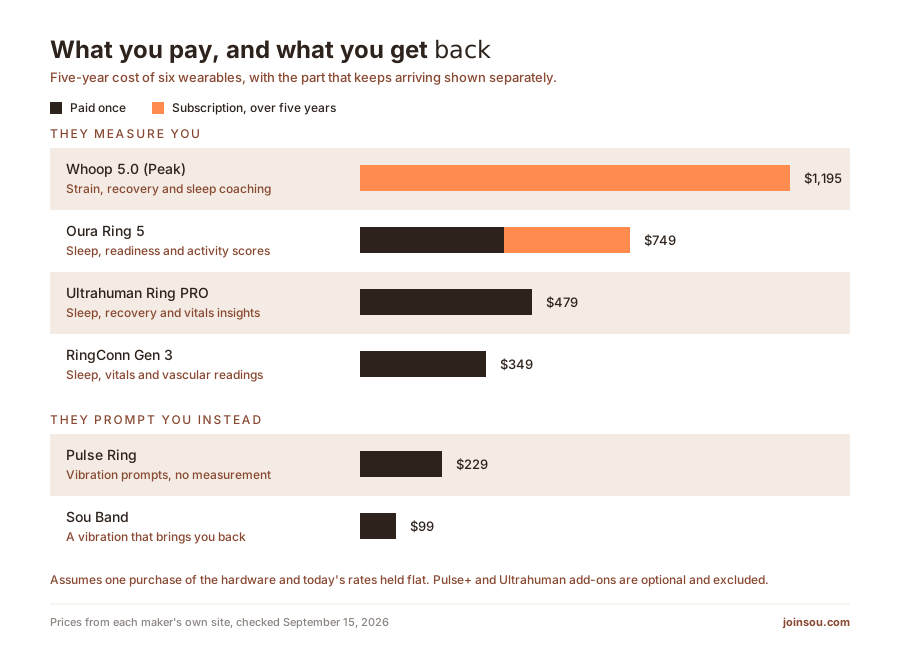
Read across the rows and the sorting question answers itself:
- Choose the RingConn Gen 3 if you want an Oura Ring 5 without the membership and price is the deciding factor. It is the cheapest full tracker here by a clear margin.
- Choose the Ultrahuman Ring PRO if you want the deepest readings of the three rings and are willing to pay the most on day one to never pay again.
- Choose Whoop 5.0 if coaching is the point rather than the hardware, and you prefer a wrist band to a ring. It is the most expensive way to be measured on this list and the most opinionated about what you should do next.
- Choose the Pulse Ring if you want prompts in a ring shape and you want to set the patterns yourself in an app.
- Choose a Sou Band if you want nothing measured or stored, and the point of wearing something is to be interrupted rather than informed.
One piece of recent history is worth clearing up, because it still shows up in older guides. In August 2025 the US International Trade Commission issued a limited exclusion order against Ultrahuman and RingConn rings in Investigation 337-TA-1398, after finding they infringed an Oura patent. RingConn then licensed the patents at issue, and the Commission published its determination removing RingConn from the order in December 2025. Ultrahuman returned to US sale in 2026 after clearance from Customs and Border Protection, reported in the trade press rather than in the Commission's own record. Both are buyable in the United States today. A patent dispute between two companies is not a reason to buy or avoid anything, and it is not evidence about how well either ring works.
If tracker-versus-tracker is the whole of your question, the most thorough guide on the subject is Heal Nourish Grow's Oura alternatives comparison, which runs ten products against a cost analysis. It does that job better than a single section here can. What follows is the branch that guide does not have.
Why do people stop wearing a health tracker?
Not for the reasons they expect. When researchers asked 159 people who had abandoned an activity tracker why they stopped, permanent abandonment was predicted by declining intrinsic motivation and disrupted routines, not by price or by doubts about accuracy. The ring did not break and the numbers were not wrong. Interest drained out of the thing, and one interrupted week was enough to end the habit.
Read as information about the product rather than as a failure of willpower, it goes in three steps:
- The readings stop being news. The first month of sleep data genuinely tells you something. By month four you can predict tomorrow's score from how last night felt.
- The routine carries the wearing, and routines break. A weekend away, a charger left behind. The object comes off and nothing in the day asks for it back.
- Nothing in the design is aimed at the moment of use. A tracker's job finishes when the reading is delivered. What you do at four in the afternoon, shoulders at your ears, is left entirely to you.
That third step is what the rest of this article is about.
Does wearing a health tracker make you more stressed?
Usually the opposite, and the honest finding is more interesting than the scare story. In a study of 237 activity-tracker owners, participants reported more positive than negative feelings while wearing the tracker: empowered, motivated, accountable. The negative feelings arrived when researchers prevented them from wearing it.
The evidence sorts cleanly:
- Supported: most owners feel more capable and more motivated while they are wearing a tracker.
- Supported: those feelings fall away when it comes off, which is a mild dependence on the object rather than on anything you learned from it.
- Not supported: that trackers make people generally more stressed. The clearest documented harm is orthosomnia, named in a 2017 Journal of Clinical Sleep Medicine paper describing patients whose pursuit of a perfect sleep score made their sleep worse. It is a three-patient case series, not a prevalence study, and anyone citing it as a percentage of users is misreading it.
So the thing to notice is not misery. It is attachment. A tracker works partly by supplying the motivation, which means it also holds it, and the relationship forms with the measuring rather than with the behavior the measuring was supposed to produce.
Where does the data from a health tracker go?
Somewhere less protected than most buyers assume. A 2025 systematic analysis in NPJ Digital Medicine read the data policies of 17 leading wearable manufacturers and found 59% rated high risk on breach notification, and just 24% rated low risk on data deletion, meaning most did not clearly explain how a person removes their own data. The authors were blunt about why the usual reassurances do not settle the question: existing frameworks including GDPR, CCPA and HIPAA “were not designed to address the continuous data streams, complex third-party ecosystems, and pervasive data collection intrinsic to wearable technologies.”
Share of 17 leading wearable manufacturers rated high risk on breach notification in a 2025 systematic analysis of data policies. Just 24% were rated low risk on data deletion. (Doherty et al., NPJ Digital Medicine, 2025)
Health readings are not a browsing history. Continuous sleep, heart rate and temperature data describe illness, pregnancy, drinking, stress and where you sleep at night, and they describe it for years. Three questions are worth asking any maker before you buy, and the answers are usually findable in a few minutes:
- Can I delete everything, in one action, and does the policy say so in plain words? Vagueness here is the finding.
- Who else receives it? Cloud processors, analytics partners and insurance or employer programs are separate answers, not one.
- What happens to my readings if the company is sold, or stops trading? Data moves with the business unless the policy says it does not.
A wearable that measures nothing skips this conversation entirely. That is not a feature its makers built so much as a consequence of the category: there is no archive to protect, because there is no archive.
Why don't you do the things you already know help?
Because knowing and doing are separated by a gap that is far wider than it feels. Reviewing decades of research on the question, Sheeran and Webb concluded that “intentions get translated into action approximately one-half of the time”. The shortfall is not caused by people who never intended to act. It is carried almost entirely by what the authors call inclined abstainers: people who formed a real intention, meant it, and did not do it.
This is the quiet problem with buying information about yourself. Almost nobody reading this needs a ring to learn that they sleep badly when they drink, or that they breathe shallowly on hard days, or that they should step outside more. That part is already known. What is missing is the moment: three in the afternoon, jaw tight, shoulders up, thinking about an email. Nothing arrives to say now. The score is in the morning. The intention was formed on Sunday. The moment goes past unmarked, and the day ends, and the number the next morning reports what happened without ever having intervened in it.
Test the gap before you spend anything. For one week, write down the single thing you would most want to do differently in a stressful moment. Then, each evening, note whether you did it. Almost everyone finds the knowledge was never missing and the moment was. That result tells you which of these two categories you are shopping in.
What if a mindfulness wearable is what you actually need?
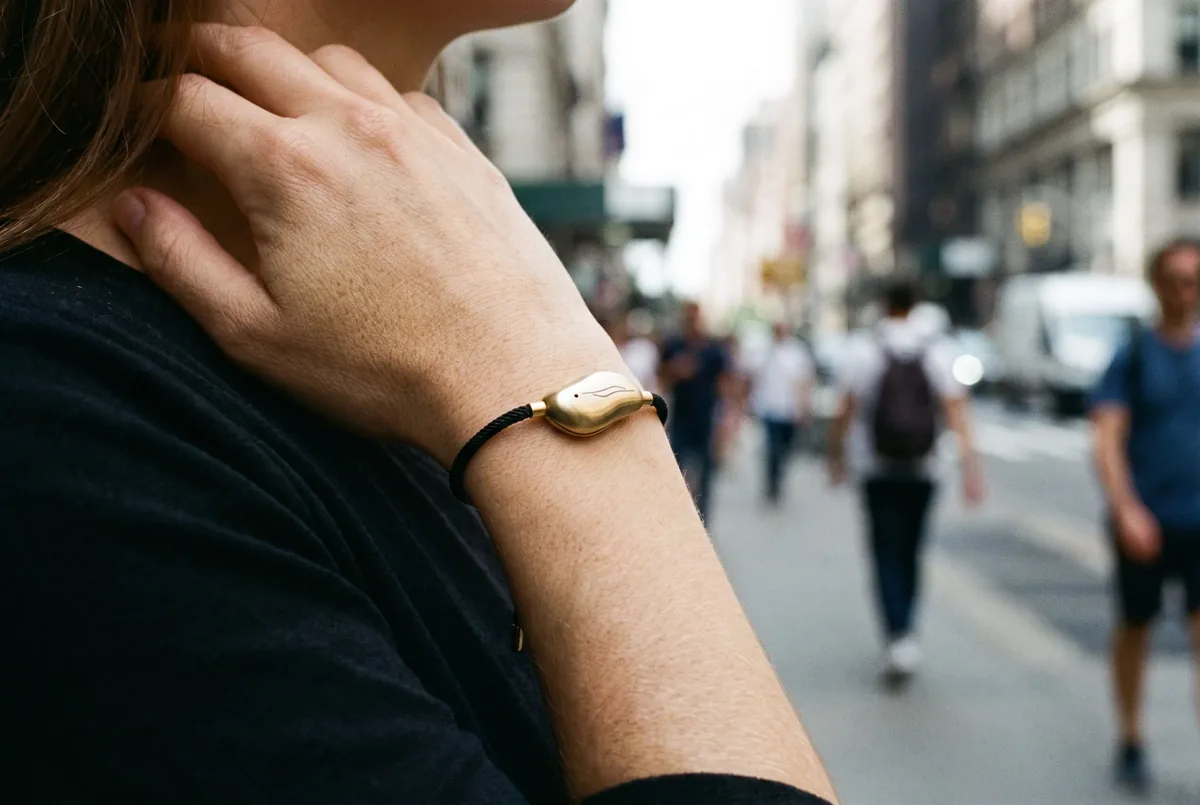
Then you are looking for an object built for that gap and nothing else. A mindfulness wearable measures nothing, stores nothing and has no opinion about your night. It vibrates, quietly, against the skin, several times a day. You feel it, you breathe, you come back. The whole event takes about three seconds and leaves no record. The reason vibration works for this is that touch does not compete for attention the way a screen does: you do not have to look at anything or decide anything, so the interruption costs almost nothing and can happen twenty times a day without becoming noise.
It suits a fairly specific person, and it is worth checking whether that is you:
- You already know what helps. Breathing, standing up, going outside, putting the phone down. The list is not the problem.
- You do not want another account. Nothing to open, nothing to review, nothing to cancel, and no archive accumulating somewhere.
- You want the prompt during the day, not a verdict the next morning. The value arrives in the moment or it does not arrive.
It is worth saying plainly what this is not. A vibration will not tell you your resting heart rate is up, and it will not catch a fever three days before you feel it. Trackers do things prompting cannot do, and for anyone managing a condition, training seriously, or troubleshooting sleep with a clinician, a ring is the right object and the membership may well be worth it. The two categories are not competing for the same job. They only look like competitors because they are both worn on the body and both sold as wellness.
Two further distinctions are worth drawing, because they are the ones most often collapsed:
- Prompting is not guided practice. An app leads you through something for ten minutes; a prompt asks nothing of you and adds no session to your day. That comparison is covered in more depth in meditation apps versus mindfulness wearables.
- Screen-free is not the same as measurement-free. A ring with no display is still gathering, still syncing, still building a profile you will open on a phone later. Losing the screen and losing the measurement are two separate decisions, and only the second one empties the archive.
Is a mindfulness wearable right for you?
It comes back to the first question, which is the only one that decides this. If you want to be measured, buy the cheapest ring that measures what you care about without charging you every year to look at it, and the table near the top of this page will settle it in about a minute. That is a real answer, and for plenty of people it is the right one.
If you have stopped wanting to be measured, the thing you are looking for is not a quieter tracker. It is an object with a different job: to arrive in the moment you would otherwise miss, and to ask nothing else of you. That category is called a mindfulness wearable, and there are several worth looking at. Sou makes one of them, the Sou Band, a small pebble worn on a wrist, ankle or necklace strap that vibrates at random intervals roughly 30 to 60 minutes apart, with no app, no account and nothing recorded. One of the testers on our homepage put what it does better than our own copy does: “I used the vibration ‘anchor’ to sway my thoughts into gratitude in whatever situation I was in.”
For more on what this category is and how it differs from the rest of the wearable market, see what is a mindfulness wearable.
The distinction underneath all of it is simple enough to carry around. One family of objects tells you what already happened to your body. The other one taps you on the wrist while it is still happening. Both are legitimate. Only you know which of those you have been missing.